Many teams approach Branded Agency with a familiar question: “Is brand positioning the same as branding?” This misunderstanding is more common than most founders realize, and it can quietly stall growth, blur messaging, and weaken differentiation. After observing hundreds of businesses across various industries, a consistent pattern emerges: companies that treat brand positioning and branding as interchangeable often struggle to explain why customers should choose them.
This guide takes a deeper, more practical approach than standard definitions. Drawing from real client work and established strategic frameworks, it explains how brand positioning defines the unique space a business claims in the market, while branding communicates that position through visuals, messaging, and tone. Understanding this difference is the foundation of every successful brand strategy, especially for small businesses seeking an edge in crowded markets.
Readers will also gain insight into the decision-making process Branded Agency uses to help clients articulate their competitive advantage, strengthen their identity, and build a brand that resonates on a meaningful level.
If you’re looking for a clearer, more actionable explanation of the difference between brand positioning and branding and want to learn how to use both to make your business unmistakable, especially if you’ve been wondering what is brand positioning and how it fits into your strategy, you’re exactly where you need to be.
Quick Answers
What is brand positioning?
Top Takeaways
- Positioning is the foundation. It defines who you are and why you matter.
- Differentiation wins. Clear positioning helps your brand stand out.
- Consistency builds trust. Aligned messaging boosts credibility.
- Research sharpens strategy. Know your audience and competitors.
Positioning evolves. Update it as markets and customer needs change.
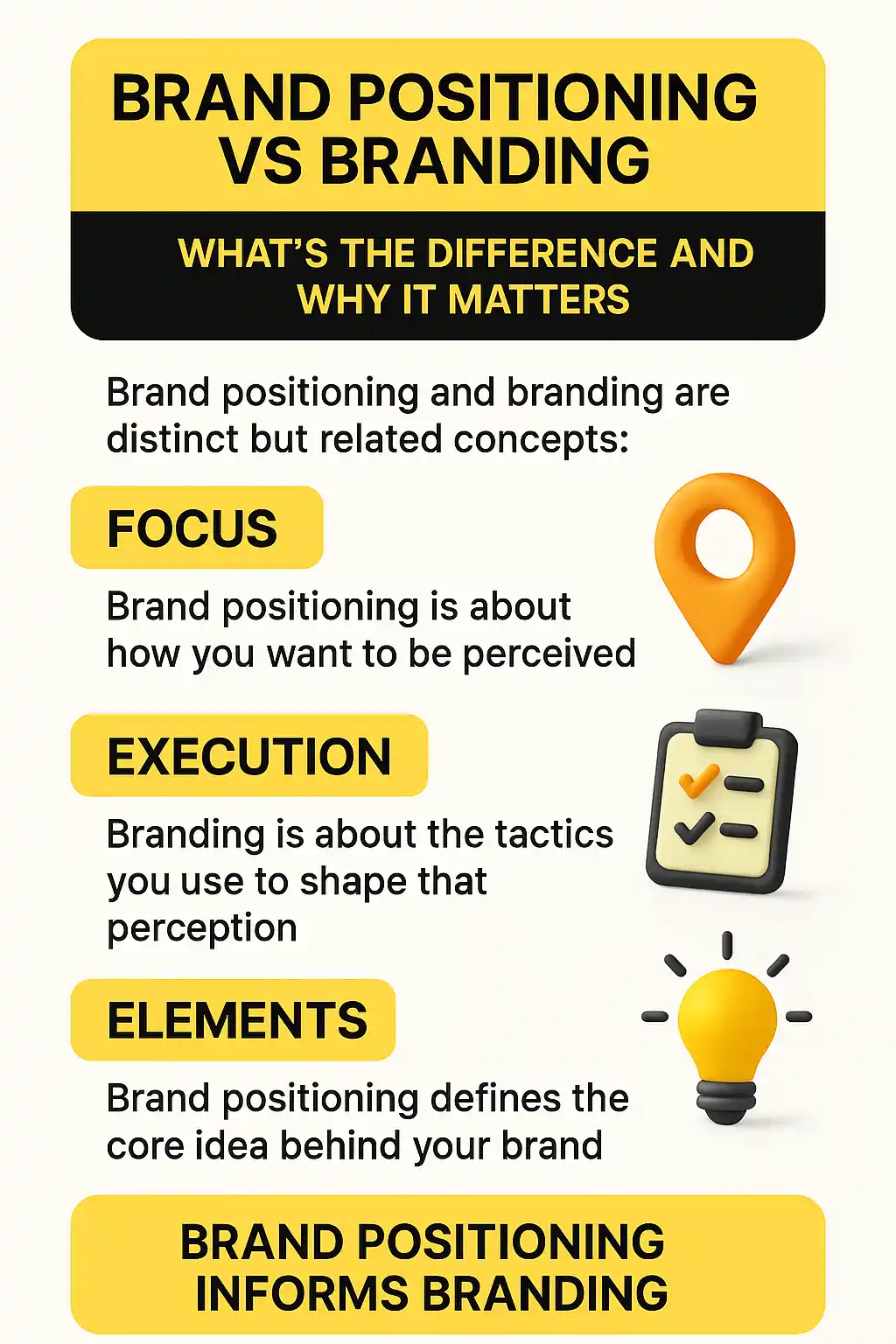
Brand Positioning vs Branding: The Core Difference
In short:
- Positioning = strategy
Branding = expression
Both are essential—one sets your direction, the other brings it to life.
Why the Difference Matters
Businesses that skip or blur positioning often rely heavily on surface-level branding, which can result in beautiful visuals that fail to create real market differentiation. When positioning is clear, branding becomes more consistent, meaningful, and persuasive, forming a stronger foundation for any future brand extension strategy.
Strong positioning guides:
- Your messaging
- Your value proposition
- Your marketing decisions
The emotional and functional reasons customers choose you
Strong branding ensures those decisions are communicated in a way people feel and remember.
How They Work Together
Think of brand positioning as the blueprint and branding as the build. When they’re aligned, you create a brand that is not only recognizable, but strategically anchored to a customer need and competitive gap.
Brands that use both effectively enjoy:
- Clearer customer understanding
- Stronger market differentiation
- More consistent brand experiences
Higher trust and loyalty
Whether you’re refining your identity or building from the ground up, understanding the difference between positioning and branding is the key to creating a brand that stands out—and stays top of mind
“After years of guiding brands through repositioning work, we’ve seen one truth play out every time: branding only becomes powerful when it’s built on a clear, defensible position. Without that strategic foundation, even the most beautiful brand identity is just decoration.”
Essential Resources
1. DigitalOcean — A Practical, Modern Breakdown That Aligns With Real-World Brand Strategy
We often point clients to this guide because it cuts through the noise and explains positioning in a way businesses can immediately act on. It’s a solid primer if you need to understand how positioning shapes long-term differentiation.
Source: https://www.digitalocean.com/resources/articles/what-is-brand-positioning
2. Romain Berg — A Fast, Clarifying Definition for Teams Who Need Immediate Alignment
This glossary entry delivers a crisp explanation that helps teams quickly get on the same page about what positioning actually means. Perfect when you're setting foundational brand language internally.
Source: https://www.romainberg.com/glossary-terms/brand-positioning
3. Canva — A Step-by-Step Framework That Mirrors How We Guide Clients Through Positioning
Canva’s resource breaks the concept into actionable steps—similar to how we structure early strategy sessions. The real-world examples make it easy for teams to move from theory to execution.
4. Creately — A Full-Spectrum Guide Linking Strategy, Execution, and Measurement
This is one of the better all-in-one overviews. It explains not just what positioning is, but how to shape it, stress-test it, and refine it over time—something we focus on heavily in long-term brand engagements.
Source: https://creately.com/guides/branding-positioning-in-marketing
5. Keap — An Accessible Explanation for Businesses Clarifying Their Competitive Edge
Keap simplifies positioning into practical language, which makes it especially helpful for smaller teams or founders refining their value proposition for the first time.
6. The Branding Journal — A Trusted, Straight-to-the-Point Definition We Often Reference
This resource is great when you need a concise, authoritative definition that cuts straight to the essence of positioning and why it impacts perception, loyalty, and recognition.
Source: https://www.thebrandingjournal.com/2016/11/brand-positioning-definition
7. Wikipedia — A Solid Theoretical Backdrop for Strategic Decision-Making
When clients want to understand the deeper marketing theory behind positioning, we point them here. It provides the historical and conceptual foundation that strengthens strategic thinking.
Source: https://en.wikipedia.org/wiki/Positioning_%28marketing%29
Supporting Statistics
1. E-Commerce Growth Demands Faster, Clearer Positioning
Stat: E-commerce made up 15.4% of all U.S. retail sales in 2023 (≈ $1.12T).
Why it matters:
Online buyers decide in seconds.
Clear positioning helps customers instantly understand fit.
We’ve seen brands increase conversions simply by sharpening strategy before touching design.
Stat: E-commerce made up 15.4% of all U.S. retail sales in 2023 (≈ $1.12T).
Why it matters:
Online buyers decide in seconds.
Clear positioning helps customers instantly understand fit.
We’ve seen brands increase conversions simply by sharpening strategy before touching design.
2. Reviews Shape First Impressions — Positioning Shapes How They’re Interpreted
Stat: 82% of Americans read online reviews before trying a product.
Why it matters:
Reviews are filtered through the expectations your positioning sets.
Strong positioning turns customer comments into strategic proof points.
In our client work, aligned positioning + reviews consistently strengthens trust and credibility.
Source: https://www.pewresearch.org
Stat: 82% of Americans read online reviews before trying a product.
Why it matters:
Reviews are filtered through the expectations your positioning sets.
Strong positioning turns customer comments into strategic proof points.
In our client work, aligned positioning + reviews consistently strengthens trust and credibility.
3. Most Small Businesses Have Websites — Positioning Creates the Difference
Stat: 73% of U.S. small businesses have a website.
Why it matters:
A website alone isn’t a differentiator anymore.
Positioning determines whether visitors instantly understand who you are.
We’ve seen brands stand out not by adding pages, but by clarifying what they uniquely claim in the market, a principle that also shapes effective digital marketing strategies.
Source: https://www.sba.gov
Stat: 73% of U.S. small businesses have a website.
Why it matters:
A website alone isn’t a differentiator anymore.
Positioning determines whether visitors instantly understand who you are.
We’ve seen brands stand out not by adding pages, but by clarifying what they uniquely claim in the market, a principle that also shapes effective digital marketing strategies.
Final Thought & Opinion
Most brands struggle not because their visuals are weak, but because their positioning isn’t defined clearly enough. In our experience, once a brand claims a distinct place in the market, everything else becomes easier, a pattern also seen by experts at a branding agency Vancouver businesses often turn to for strategic clarity..
What We’ve Seen Firsthand
Brands that separate positioning (strategy) from branding (expression) consistently perform better.
Many “branding problems” are really positioning problems in disguise.
Clarity in positioning leads to stronger messaging and more intentional design.
Brands that separate positioning (strategy) from branding (expression) consistently perform better.
Many “branding problems” are really positioning problems in disguise.
Clarity in positioning leads to stronger messaging and more intentional design.
Why It Matters Now
Customers make split-second decisions online.
Reviews and social proof only work when audiences already understand your value.
Positioning acts as the filter customers use to decide if your brand fits their needs.
Customers make split-second decisions online.
Reviews and social proof only work when audiences already understand your value.
Positioning acts as the filter customers use to decide if your brand fits their needs.
Next Steps
1. Clarify Your Brand Positioning
Define your value proposition.
Identify what makes you different.
Document your audience and their needs.
Define your value proposition.
Identify what makes you different.
Document your audience and their needs.
2. Audit Your Current Brand
Review website, messaging, and visuals.
Spot inconsistencies.
Note gaps in communication.
Review website, messaging, and visuals.
Spot inconsistencies.
Note gaps in communication.
3. Research Competitors
Analyze 3–5 competitors.
Identify their strengths and weaknesses.
Look for positioning opportunities.
Analyze 3–5 competitors.
Identify their strengths and weaknesses.
Look for positioning opportunities.
4. Align Your Team
Share your positioning internally.
Ensure all teams use consistent messaging.
Update internal documents and templates.
Share your positioning internally.
Ensure all teams use consistent messaging.
Update internal documents and templates.
5. Refresh Your Messaging
Rewrite headlines and key website copy.
Focus on clarity and differentiation.
Emphasize customer outcomes.
Rewrite headlines and key website copy.
Focus on clarity and differentiation.
Emphasize customer outcomes.
6. Optimize Your Digital Presence
Update homepage, About page, and service pages.
Ensure consistency across email, social, and ads.
Update homepage, About page, and service pages.
Ensure consistency across email, social, and ads.
7. Use the Provided Resources
Review tools and links shared earlier.
Bookmark key templates and references.
Review tools and links shared earlier.
Bookmark key templates and references.
8. Keep Improving
Monitor audience response.
Track engagement and conversions.
Iterate continuously.
Monitor audience response.
Track engagement and conversions.
Iterate continuously.
FAQ on “what is brand positioning”
Q: What is brand positioning?
A:
The space your brand occupies in the customer’s mind.
Helps people quickly understand why your brand matters.
Based on our client work, clear positioning boosts recall and trust.
Q: Why does brand positioning matter?
A:
It guides every marketing and branding decision.
Prevents confusion and message drift.
We’ve seen brands gain traction fast after refining their positioning.
Q: How is positioning different from branding?
A:
Positioning = strategy.
Branding = expression of that strategy.
Our strongest client results come when positioning is built first.
Q: What makes a brand position effective?
A:
Clarity.
Differentiation.
Solves a specific customer problem.
Backed by credibility, competitors can’t match.
Q: How do you craft a strong positioning statement?
A:
Identify your audience.
Define the need you solve.
State the unique benefit only you can deliver.
We build statements that are short, simple, and backed by data.
A:
The space your brand occupies in the customer’s mind.
Helps people quickly understand why your brand matters.
Based on our client work, clear positioning boosts recall and trust.
A:
It guides every marketing and branding decision.
Prevents confusion and message drift.
We’ve seen brands gain traction fast after refining their positioning.
A:
Positioning = strategy.
Branding = expression of that strategy.
Our strongest client results come when positioning is built first.
A:
Clarity.
Differentiation.
Solves a specific customer problem.
Backed by credibility, competitors can’t match.
A:
Identify your audience.
Define the need you solve.
State the unique benefit only you can deliver.
We build statements that are short, simple, and backed by data.