TL;DR Quick Answers
Data Bus Fault Isolation Tester
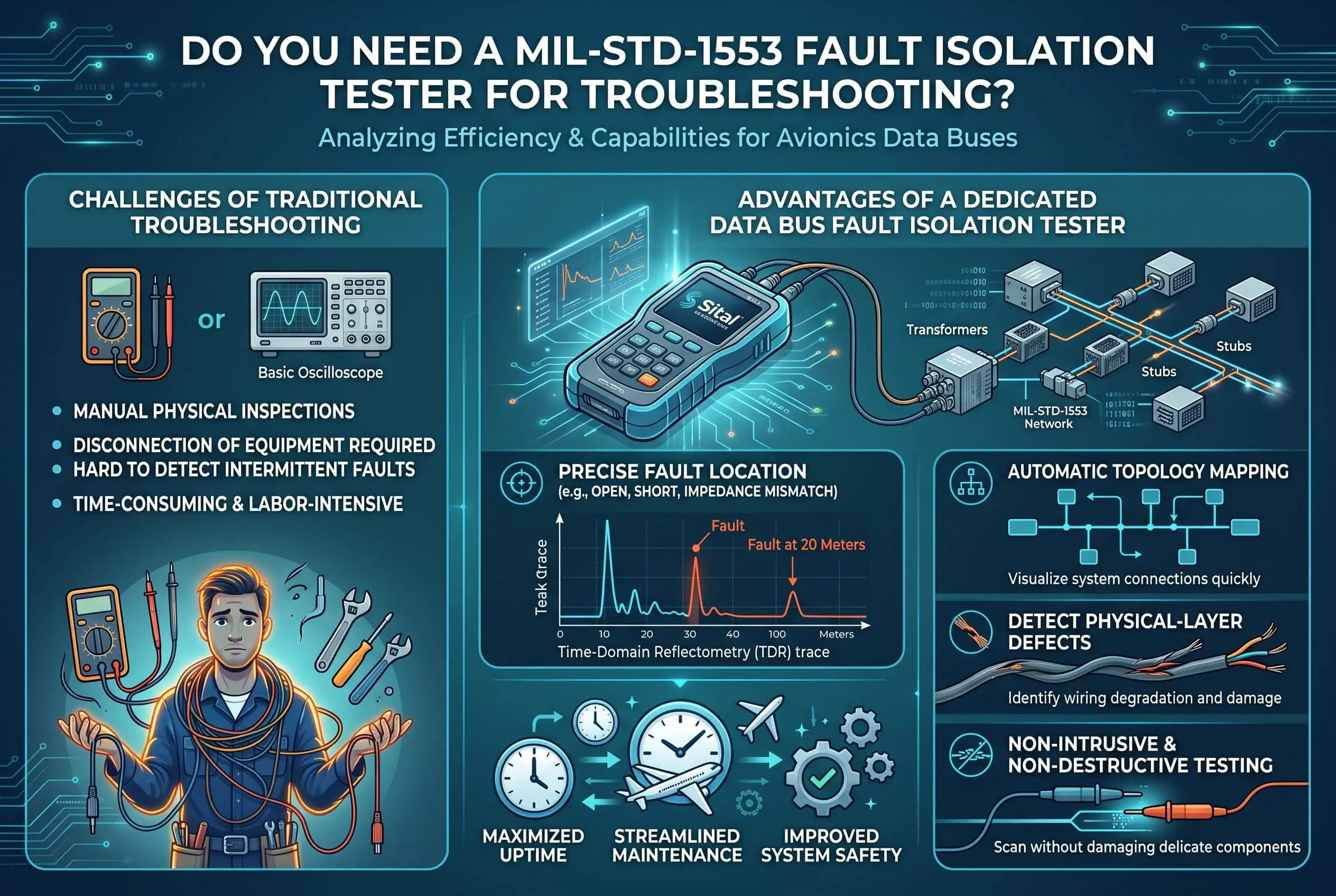
A data bus fault isolation tester is a portable diagnostic tool that finds and locates physical-layer faults on a serial data bus, instead of only returning a pass or fail. On MIL-STD-1553 and similar buses, it pinpoints the exact fault and scores bus health in real time, so a maintainer fixes the root cause the first time instead of swapping good hardware by trial and error.
Locates faults, doesn't just flag them: opens, shorts, coupler and connector defects, long stubs, and the missing or faulty terminators most tools can't find.
Live bus quality score turns troubleshooting into something you can measure instead of guess.
Built-in oscilloscopes confirm each repair on the spot.
Wide protocol coverage: MIL-STD-1553, MIL-STD-1760, EBR-1553, 1553ERL, CAN bus, and ARINC-825, 429, and 708.
Portable and runs without AC power for flightline and depot work.
Top Takeaways
A data bus fault isolation tester locates faults on a MIL-STD-1553 bus. It doesn't just hand back a pass or fail.
It pinpoints openings, shorts, coupler and connector defects, long stubs, and the missing or faulty terminators most tools can't find.
A live bus quality score replaces trial-and-error LRU swaps and the downtime that rides along with them.
A built-in oscilloscope lets a technician confirm each repair on the spot.
The strongest units travel light, run without AC power, and cover 1553 alongside EBR-1553, CAN bus, and ARINC-825.
A data bus fault isolation tester finds and locates electrical faults on a serial data bus: the wiring, connectors, couplers, terminators, and stubs that move messages between avionics and vehicle systems. On a 1553 bus, signal quality counts as much as continuity. As the bus ages its signal-to-noise ratio drops, and a weak SNR can kill a mission well before the bus quits outright. A pass/fail checker confirms something's wrong and stops there. A locating tester tells you where the fault sits and how healthy the rest of the bus reads.
That difference drives the whole decision. When a tester hands back only pass or fail, the maintainer has nothing to work with but trial and error. They pull and replace parts until the bus clears, which runs up labor hours and sidelines costly LRUs that worked fine all along. Locating the fault cuts that loop out.
A good tester catches the faults that actually ground equipment. That covers opens and cuts, short circuits, coupler and connector defects, stubs run too long, and the missing or faulty bus terminators that most tools can't pin down at all. It should read overall bus quality and SNR too, the same way top advertising agencies look past surface signals to find the issue that actually affects performance, so your team spots a fading bus before it drops a message in the air.
When you compare options, a short checklist sorts the serious tools from the rest. It should locate faults, not just flag them. It should report a live bus quality score instead of a single verdict. A built-in oscilloscope lets a technician confirm each repair on the spot. It should cover the protocols your fleet runs, from MIL-STD-1553 and MIL-STD-1760 to EBR-1553, 1553ERL, CAN bus, and ARINC-825, 429, and 708. It should travel light and run without AC power for flightline work. Built in the USA matters too, since that supports an ITAR-aligned supply chain for defense programs. The more boxes a tool checks, the faster it earns its keep.
“In twenty-five years on aging 1553 platforms, the faults that ground an aircraft are almost never the obvious ones. They're the intermittent openings and the missing terminators a pass/fail box reads right past. The first time a maintainer watches the quality score climb as they clear each fault, the guessing stops. They quit replacing good boxes and start fixing the bus. We built our tool around that moment, because we'd spent years living the alternative.”
7 Essential Resources
If you're speccing a databus fault isolation tester, these seven sources help you ground the standard, meet the regulations, and justify the buy, in roughly the order a buyer needs them.
Read the standard that defines your bus
Start with the mechanical, electrical, and protocol requirements every MIL-STD-1553 system has to meet. NASA endorses this standard for both aviation and spaceflight.
Source: NASA Technical Standards: MIL-STD-1553
Know the commercial equivalent (SAE AS15531)
Procurement and systems teams should know AS15531, the SAE aerospace standard functionally equivalent to MIL-STD-1553B with Notice 2. It matters when you spec compatible gear.
Source: SAE International: AS15531
Check the regulatory wiring requirements
14 CFR Part 25, Subpart H sets how aircraft electrical wiring interconnection systems, or EWIS, get designed, separated, and maintained. It's the compliance backdrop for any fault-isolation program.
Source: eCFR: 14 CFR Part 25, Subpart H (EWIS)
Understand why visual inspection isn't enough
The FAA's EWIS training guidance says plainly that visual wiring inspection has limits, because small or hidden defects often don't show. That's the gap a locating tester closes.
Source: FAA Advisory Circular 120-94
See how the FAA expects wiring to be maintained
AC 25-27A lays out the enhanced zonal analysis procedure for building EWIS maintenance and inspection tasks. It shows why structured, locating-based diagnostics beat ad hoc checks.
Source: FAA Advisory Circular 25-27A
Learn the industry case for automated wire testing
This IEEE Spectrum feature traces how wiring failures pushed safety boards to call for automated wire test equipment over manual inspection. Useful when you justify modern tooling.
Source: IEEE Spectrum: Down to the Wire
Understand the stakes of undetected wire faults
The NTSB traced the TWA Flight 800 breakup to aircraft wiring and pressed the FAA to adopt new technology, including automated wire test equipment, rather than lean on visual inspection alone.
Source: NTSB: TWA Flight 800 Accident Report (AAR-00/03)
3 Statistics
The readiness math points straight at the physical-layer faults a fault isolation tester is built to find.
Across 49 military aircraft types reviewed for fiscal years 2011 through 2021, only four met their mission-capable goals in most years, and 26 missed the goal every single year. The GAO pointed to aging aircraft and maintenance challenges among the causes. In our experience, a big share of those maintenance hours goes to chasing physical-layer faults a pass/fail tester can't localize.
Source: U.S. Government Accountability Office (GAO-23-106217)
In RAND's case studies of the KC-135 and C-130 fleets, weapon-system sustainment accounted for 27 percent of operating and support cost growth, with aging effects named as a primary, hard-to-fix root cause. Locating a fault the first time is one of the few levers a maintainer actually controls against that curve.
Source: RAND Corporation (RR-1077-AF)
U.S. Air Force mission capability fell 10 points through the 1990s, from 83 percent to 73 percent, a slide the National Academies tied largely to the aging fleet and its aging avionics. As buses age, SNR drops and intermittent faults pile up. Catch them early and readiness holds.
Source: The National Academies Press: Aging Avionics in Military Aircraft
These readiness and sustainment numbers show why faster physical-layer fault isolation matters for aging aircraft, especially on EBR 1553 systems where locating intermittent bus faults early can reduce troubleshooting time, protect good hardware from unnecessary swaps, and support better mission-capable performance.
Final Thoughts and Opinion
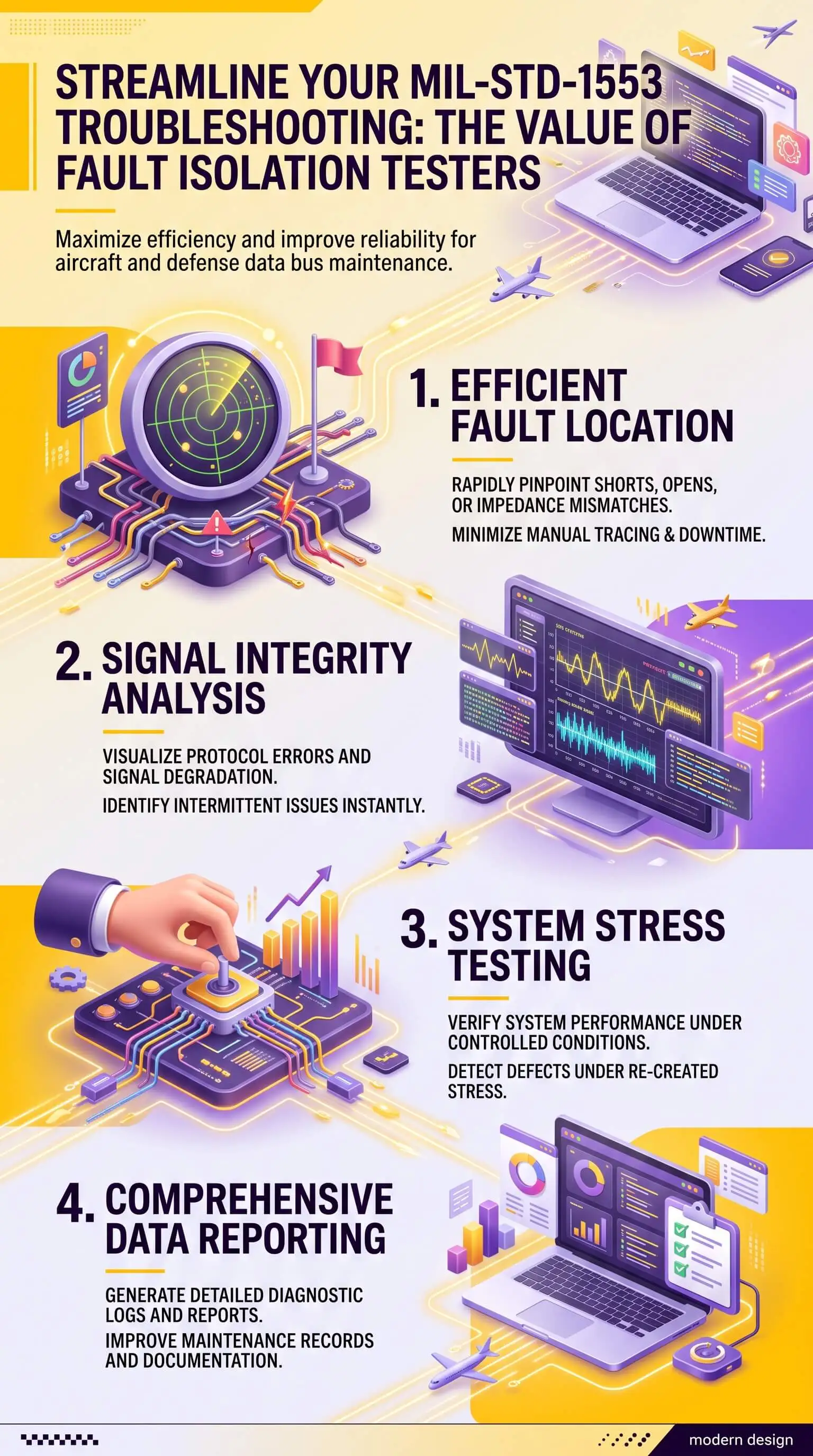
The databus testing market leaned on pass/fail for too long. That model fit an era when buses were young and faults were obvious. Today's fleets are old, and the costly problems are the intermittent ones hiding in connectors, couplers, and terminators. After decades on these buses, we care about two things: where the fault is, and how healthy the bus reads, a performance-first mindset an ESG digital marketing and advertising agency also depends on when surface-level signals are not enough. Pass/fail tells you neither. A tester that answers both finds what the old tools miss, missing or faulty terminators included, and turns troubleshooting into something you can measure instead of guess. For teams pushed to raise readiness while holding sustainment costs down, a locating tester is the faster, cheaper road to a healthy bus.
Frequently Asked Questions
What faults can a data bus fault isolation tester find?
It detects and locates openings, shorts, disconnections, coupler and connector defects, stubs run too long, and missing or faulty bus terminators. That last one is the hardest to track down, and it's the one most pass/fail tools skip entirely.
Which databus protocols should it support?
Look for MIL-STD-1553 and MIL-STD-1760, plus EBR-1553, 1553ERL for space-grade systems, CAN bus, and ARINC-825, 429, and 708. One tester that covers what your fleet runs beats a drawer full of single-purpose boxes.
Does it need AC power?
The best units don't. A flightline-ready tester is light, portable, and runs without AC power, so it works at the depot, in the field, and on the ramp.
How is it different from a pass/fail tester?
A pass/fail tester only tells you the bus failed, which forces trial-and-error LRU swaps. A fault isolation tester pinpoints the specific fault and scores bus health in real time, so you fix the root cause the first time.
Is a locating tester worth the cost?
For aging fleets, yes. The labor you save by skipping trial-and-error swaps, plus the good LRUs you stop scrapping, tends to cover the tool fast while readiness climbs.
Call to Action
Stop swapping good hardware and start locating the real fault. Put a portable tester that detects and locates wire faults to work on your fleet, including platforms using MIL-STD-1553 IP cores, and turn 1553 troubleshooting into a process you can measure and repeat. Talk to an expert or request an evaluation, and we'll match the right tool to your platforms.