If last month's numbers made you uneasy, start there. Most Santa Barbara small businesses need a bookkeeper first, an accountant at tax time, and both once growth starts outpacing the systems behind it.
Think of a Funk Zone tasting room heading into harvest, or a coastal nonprofit with a grant report due Friday. Both need clean, current books every month. Only one of them may need forecasting this quarter. A good Santa Barbara bookkeeper keeps the record accurate, and an accountant turns that record into tax filings and decisions you can make with clarity instead of guesswork.
I've sat across the table from owners doing their own bookkeeping after the kids were asleep, and almost none of them opened with "which professional should I hire?" What they wanted to know was why they didn't trust their own numbers. That question has a practical answer, and it depends on where your business sits right now.
TL;DR Quick Answers
Santa Barbara Bookkeeper
A Santa Barbara bookkeeper records, reconciles, and closes your books each month so you can make decisions with clarity instead of guesswork. Most local small businesses should hire one before they need an accountant.
What they handle: transactions, bank and card reconciliations, payables and receivables, payroll support, and month-end close.
When to hire one: your books are a month or more behind, or you can't pull last month's profit and loss.
Local cost: recent Santa Barbara postings ran about $25 to $40 an hour before payroll taxes and benefits. Outsourced firms usually charge a flat monthly or weekly fee instead.
Why it matters here: tourism swings, harvest-season payroll, and nonprofit grant reporting make clean monthly books essential on the Central Coast.
What to look for: a team that can grow from bookkeeping into accounting oversight and CFO guidance, so you don't switch providers as you scale.
Top Takeaways
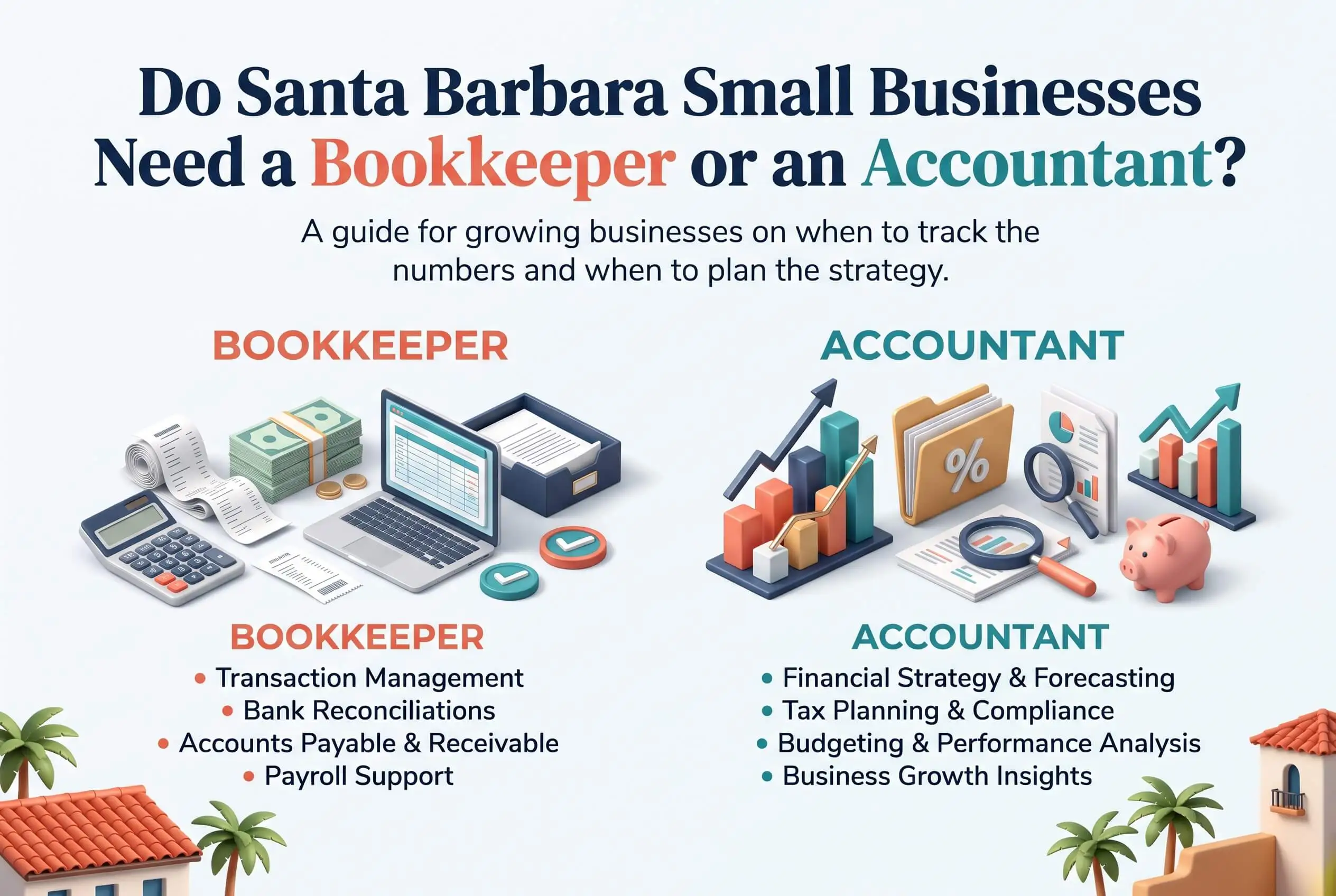
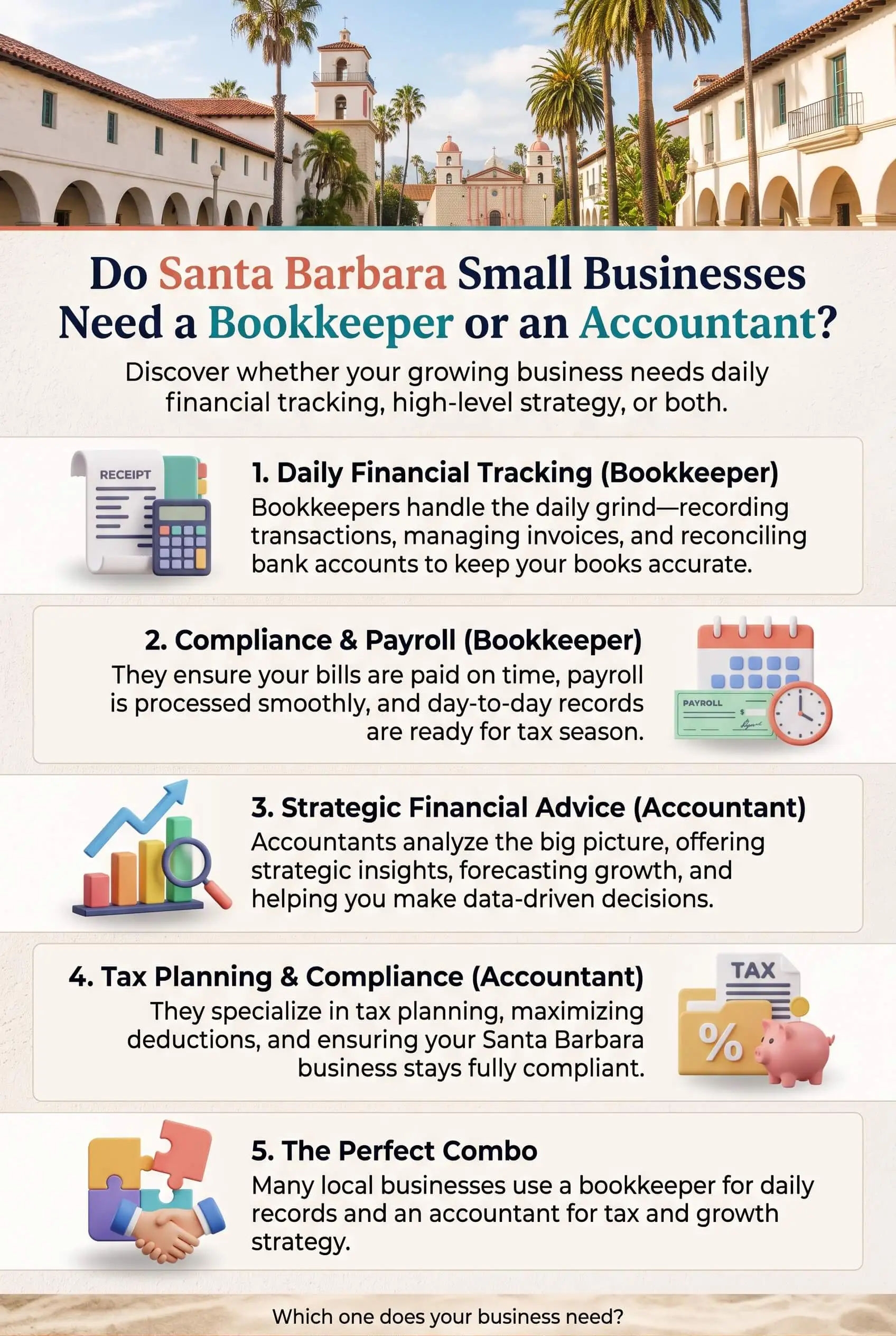
Bookkeepers keep daily records accurate, while accountants interpret those records for taxes and planning.
Most small businesses start with a bookkeeper and add accounting as complexity grows.
Only state-licensed professionals can use the CPA title in California, so check the license before you hire.
Seasonal revenue, inventory, and grant reporting make clean monthly books especially valuable on the Central Coast.
Catching up costs more than keeping up, so don't wait for tax season to start.
Bookkeeper vs Accountant: What Each One Does
A bookkeeper records and reconciles every transaction so your books stay accurate month to month. An accountant reviews those records and uses them for taxes, reporting, and forward-looking decisions. Put simply, the bookkeeper tells you where the money went, and the accountant helps you decide where it should go next.
What a Santa Barbara Bookkeeper Handles Each Month
Recording sales, expenses, and deposits as they happen
Reconciling bank and credit card accounts
Managing accounts payable and accounts receivable
Supporting payroll and contractor payments
Getting the books ready for month-end close
What an Accountant or CPA Adds
Reviewing and preparing financial statements
Tax planning and filing
Guidance on entity structure, budgets, and cash flow
Support when lenders, investors, or auditors ask questions
Owners often miss one distinction. In California, only someone licensed by the state Board of Accountancy can use the title Certified Public Accountant. The U.S. Bureau of Labor Statistics notes that CPA candidates must pass a national exam and complete 150 semester hours of college coursework. Plenty of skilled accountants aren't CPAs. If you need representation on a complex tax matter or reviewed financial statements, though, ask about the license before you sign anything.
Bookkeeper at a glance:
Core job: records and reconciles transactions
Timing: daily to monthly
Typical credential: training or certification, with no license required
Typical cost basis: hourly or a monthly flat fee
Best for: keeping current, reliable books
Accountant at a glance:
Core job: analyzes, reports, advises, and files
Timing: monthly to annually
Typical credential: accounting degree, plus a CPA license for public accounting
Typical cost basis: hourly, by project, or by engagement
Best for: taxes, planning, and decisions with real money on the line
Signs Your Business Needs a Bookkeeper, an Accountant, or Both
Start with the problem you're actually feeling. It usually points to the right hire.
You need a bookkeeper when:
Your books are more than a month behind
Evenings disappear into data entry
Personal and business spending share an account
You can't pull last month's profit and loss without a scramble
You need an accountant when:
You're hiring your first employees
A loan or line of credit is on the table
You're changing your entity type or planning a sale
Sales tax or out-of-state revenue is entering the picture
You need both when:
Revenue is climbing and you want forecasts, not only history
Your accountant spends tax season cleaning up the books before any tax work begins
We see that last situation constantly. The fix works like a ladder, starting with consistent bookkeeping, then outsourced accounting for oversight, then fractional CFO guidance once strategy needs a seat at the table. Working with a Santa Barbara bookkeeper whose team can grow into accounting and CFO support, as Accountix does, means you won't have to switch providers every time the business outgrows the last one.
What Changes the Answer in Santa Barbara
Local conditions shift the timing more than most owners expect.
Seasonal cash swings. Summer visitors and event weekends drive revenue for hospitality and retail. Monthly reconciliations catch problems before the slower winter months expose them.
Wine and agriculture. Inventory, seasonal payroll, and harvest timing make clean books essential and bring accountant input in earlier.
A deep nonprofit community. Fund accounting and grant reporting need more structure than general bookkeeping usually provides.
Local labor costs. Recent Santa Barbara bookkeeper postings ranged from about $25 to $28 an hour for contract work up to $34 to $40 for temporary placements. Payroll taxes and benefits push an in-house hire well past the hourly rate.
Cloud-based support. An outsourced team can work with a business in Goleta or Carpinteria just as easily as one on Anacapa Street, so location doesn't narrow your options.
Picking financial help isn't so different from picking any outside partner. The same questions come up when comparing marketing companies: what exactly will they own, and can they keep up as you grow?
"Owners usually call us asking for an accountant, and more often than not what's actually missing is a reliable monthly close. Once the accounts reconcile and the month closes on time, the tax conversation gets shorter and the planning conversation can finally start. I watched a small winery owner go from losing hours to the books every week to reading a clean monthly report and getting back to the business. The winery didn't change. The owner just trusted the numbers. That's the order I'd recommend to anyone in Santa Barbara: get the history right first, then ask what it's telling you."
7 Essential Resources
1. Bookkeeping, Accounting, and Auditing Clerks (U.S. Bureau of Labor Statistics)
If you're weighing an in-house hire, read this first. It lays out what bookkeepers do day to day, how they train, and what the role pays nationally.
2. Accountants and Auditors (U.S. Bureau of Labor Statistics)
https://www.bls.gov/ooh/business-and-financial/accountants-and-auditors.htm
Breaks down the different kinds of accountants, from management to public accounting, along with what the CPA path requires. Handy when you're not sure which type your situation calls for.
3. CPA License Lookup (California Board of Accountancy)
https://www.dca.ca.gov/cba/consumers/license-lookup.shtml
The official place to confirm a California CPA's license status. It takes about two minutes, and it's worth doing before any engagement letter gets signed.
4. Common Questions About Recordkeeping for Small Businesses (IRS)
https://www.irs.gov/newsroom/common-questions-about-recordkeeping-for-small-businesses
Quick answers on what to keep, how long to keep it, and why proof of expenses matters. Use it as a baseline for what your bookkeeper should be maintaining.
5. 2025 Small Business Profile: California (SBA Office of Advocacy)
https://advocacy.sba.gov/wp-content/uploads/2025/06/California_2025-State-Profile.pdf
State data on how many small businesses operate in California and where they employ people. Useful background if you're planning growth or preparing for a lender conversation.
6. Bookkeeping vs Accounting (QuickBooks)
https://www.quickbooks.intuit.com/r/bookkeeping/bookkeeping-vs-accounting/
A plain-language comparison of each role's duties and credentials, written by the software company many local bookkeepers work in every day.
7. Bookkeeper vs. Accountant: Which Is Better for Your Business? (LegalZoom)
Helps you decide when a general accountant is enough and when a CPA is worth it, with notes on entity selection and lender reporting.
3 Statistics
$50,670 a year
The U.S. Bureau of Labor Statistics put the national median wage for bookkeeping, accounting, and auditing clerks at $50,670 in May 2025. Santa Barbara pay and California payroll costs push an in-house hire higher than that, which is a big reason so many local owners outsource.
Source: U.S. Bureau of Labor Statistics
$83,680 a year
Accountants and auditors earned a national median of $83,680 in May 2025, according to the same agency. Few small businesses need that skill set 40 hours a week, so buying accountant time by the project or engagement usually pencils out better.
Source: U.S. Bureau of Labor Statistics
4.2 million small businesses
California has 4.2 million small businesses, accounting for 99.9% of all firms in the state and 47.1% of its employees, per the SBA Office of Advocacy. If you're sorting out who should handle your books, you're far from the only owner asking.
Source: SBA Office of Advocacy, California Small Business Profile
Final Thought
My honest take is that "bookkeeper or accountant?" matters less than the order you bring them in. For nearly every growing business I've seen, accurate books come first and expert interpretation follows.
An accountant working from messy records spends your money on cleanup. A bookkeeper with no accountant reviewing the work can keep a perfect record of decisions nobody questioned. Each role gets stronger when the other is in place.
Waiting costs more. Catch-up bookkeeping always takes longer than steady monthly upkeep, and it tends to land in a rush right before a tax deadline or a loan application. Owners who build the habit early decide with clarity instead of guesswork, and that steadiness carries into everything from hiring to digital marketing budget planning, helping businesses track campaign expenses, allocate resources wisely, and support purpose-driven growth.
So begin where it hurts. If you don't trust last month's numbers, bring in a bookkeeper. If you trust them but can't tell what they mean for next quarter, that's accountant territory. And if both sound familiar, look for one local team that covers the whole climb.
Frequently Asked Questions
How much does a bookkeeper cost in Santa Barbara?
Recent postings for a Santa Barbara bookkeeper ran roughly $25 to $40 an hour, before payroll taxes and benefits. Outsourced firms usually charge a monthly or weekly fee based on transaction volume and complexity, which often comes in under the cost of an in-house hire.
Can a bookkeeper file my business taxes?
Some bookkeepers prepare returns, but filing is usually an accountant's job. California law requires anyone who prepares returns for a fee and isn't a CPA, enrolled agent, or attorney to register with the California Tax Education Council. In most businesses, the bookkeeper organizes the records and the accountant files.
Do I need a CPA or just an accountant?
A non-CPA accountant can cover reporting, budgeting, and plenty of tax work. Go with a CPA when you need reviewed or audited financial statements, representation on a complicated tax issue, or the accountability that comes with a state-regulated license.
How do I check whether a California CPA is licensed?
Use the California Board of Accountancy's free online license lookup. Search by name or license number to confirm the license is active and see any public enforcement history. It's a two-minute step worth taking every time.
How long should my business keep financial records?
The IRS's general rule is three years after you file, and employment tax records need at least four. Keep records for six years if you left out income worth more than 25% of the gross income on your return, and hold property records until the limitations period ends for the year you sell.
Ready to Get Your Books in Order?
Take ten minutes this week to look at where your books actually stand: how current they are, and whether you'd make a decision from them today. Then talk with a local team that can match support to your stage, whether that's monthly bookkeeping, accounting oversight, or both. Remote outsourced QuickBooks bookkeeping services give businesses the flexibility to access accurate financial records, stay organized, and receive professional support without the added expense of an in-house team. A 30-minute intro conversation with no sales pitch is usually enough to see the next step clearly.
How do you split bookkeeping and accounting in your business today? Tell us what's working, or what isn't, in the comments below.


