Your renewal quote arrives, and the number is nearly double what you paid two years ago. Most owners assume they're being charged for growing. They aren't, exactly. Bookkeeping providers price the hours it takes to record, reconcile and close a month of books, and growth adds those hours through more transactions, more bank and card accounts, more people on payroll and reports that have to answer harder questions.
Revenue climbs alongside all of that, so it takes the blame. Look closer and something specific usually changed, like a second location, a new Shopify store, four new hires or a lender who now wants accrual statements.
Bookkeeping is the running record of every dollar that moves through a business, and when dollars move in more directions, keeping that record accurate takes longer. If you pay for outsourced bookkeeping services, it helps to know which changes move the price. Then you can budget for the fair increases and question the ones nobody can explain.
TL;DR Quick Answers
Outsourced Bookkeeping Services
Outsourced bookkeeping services hand your recurring books to an outside team that records transactions, reconciles accounts, handles AP and AR, categorizes payroll and closes each month with reports you can act on. Pricing follows workload rather than revenue, so the cost rises as transactions, accounts and reporting needs grow.
What's included: transaction management, account reconciliations, accounts payable and receivable, payroll categorization and a monthly close with financial reports.
What it costs: Accountix publishes starting rates from $200 per week for businesses under $2 million in revenue, with final pricing scoped to your workload.
What raises the price: transaction volume, added bank accounts and payment platforms, headcount, multiple entities and accrual reporting.
What separates good from cheap: the month-end closes. A provider that categorizes transactions but never reconciles the balance sheet is doing data entry.
How to choose: pick fixed, scoped pricing over hourly billing, and ask up front what would trigger a change in scope.
When to move up: once you need budgets, forecasts or controller-level review, step up to outsourced accounting.
Top Takeaways
Transactions, accounts, payroll and reporting depth set the price of bookkeeping far more than revenue does.
Seven triggers drive most increases, and growing businesses usually hit two or three at once.
Each tier up adds a new kind of work, from faster cadence to oversight to forward planning.
Fixed, scoped pricing protects you from busy-month spikes that hourly billing passes straight through.
Ask any provider what would trigger a scope change, and review your scope once a year.
Why Bookkeeping Costs Track Workload, Not Revenue
A bookkeeping provider scopes your account by asking how long a month of books takes to record, reconcile, review and close. Revenue gives them a rough guess at that, and not much more.
Take two businesses. A consultancy billing $3 million a year might send 40 invoices a month and pay a handful of vendors. A restaurant doing $1 million runs thousands of card transactions, daily deposits, tipped payroll and weekly inventory counts. The restaurant is the bigger bookkeeping job by a wide margin, and it usually costs more to keep.
So when your bill goes up, ask what got more complicated over the past year. That answer explains the price far better than your top line does.
Seven Growth Triggers That Raise Outsourced Bookkeeping Costs
These are the changes we see push a scope up most often. Most growing businesses hit two or three at once.
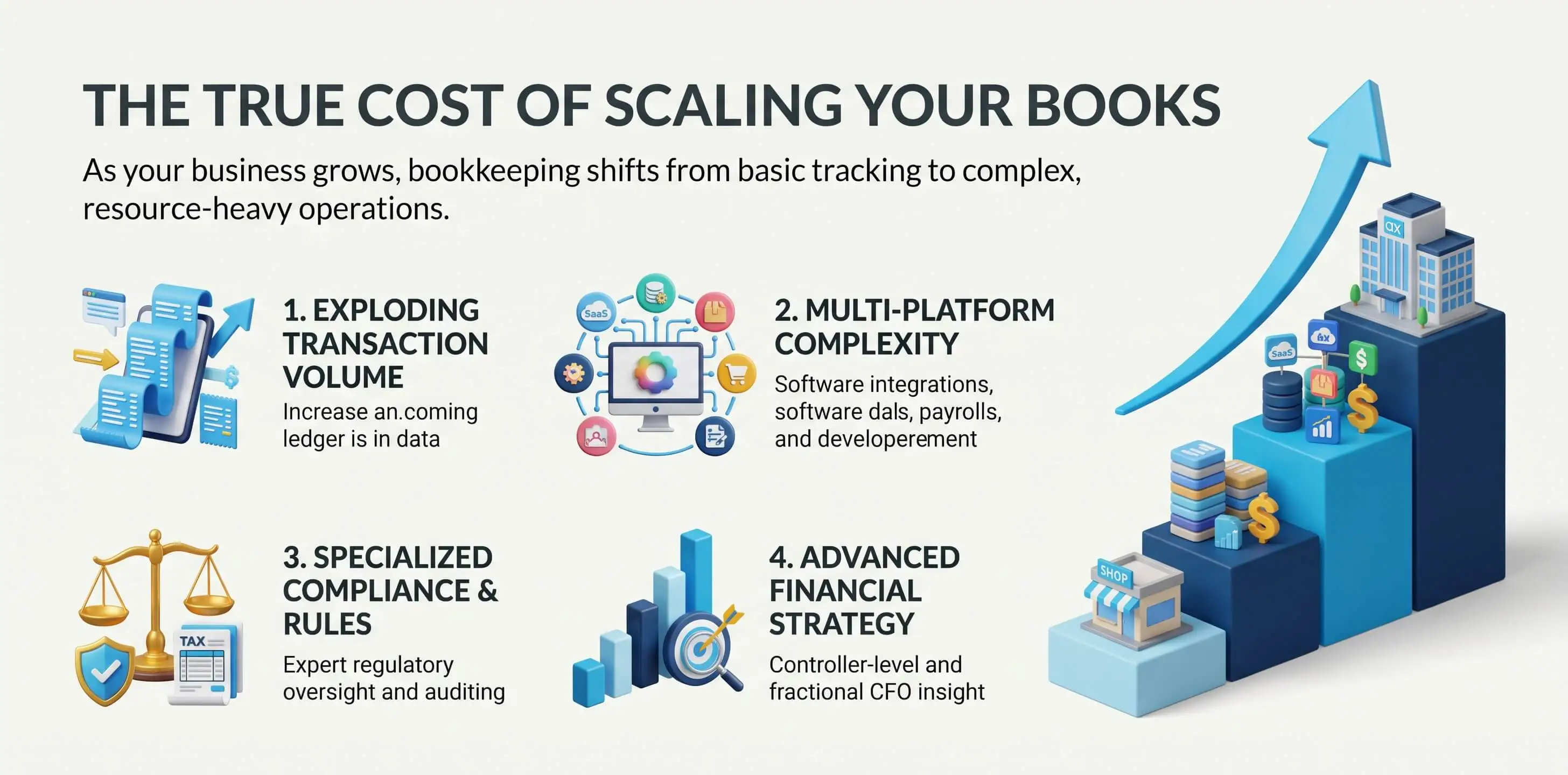
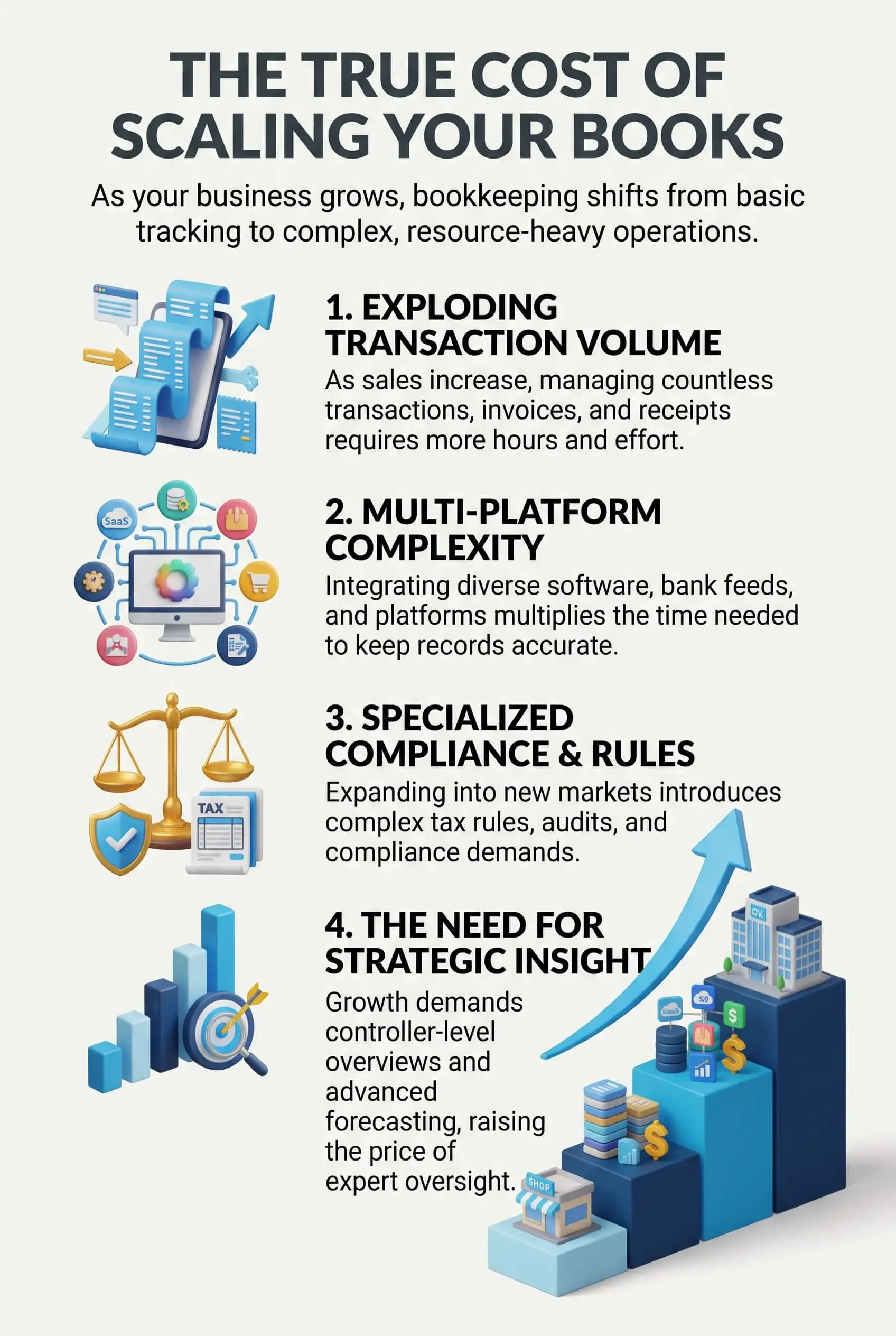
Transaction volume. Your provider categorizes every transaction and matches it to a statement later, so going from a few hundred entries a month to a few thousand adds real hours.
More accounts and platforms. Every bank account, credit card and payment processor gets its own reconciliation each month. Adding Stripe, Square or Shopify adds one more.
Accounts payable and receivable. More vendors and customers mean more bills to enter and approve, plus a longer list of invoices to chase.
Payroll and headcount. Someone records payroll, allocates it to the right accounts and ties it back to the books every cycle. Going from 5 employees to 25 multiplies that work.
Multiple entities or locations. A second location, a holding company or employees in new states means separate books, intercompany entries and a consolidated report on top.
Specialized tracking. Inventory, job costing and restricted grants each need their own accounts and a closer review, especially if you want margins by project.
Accrual reporting. Once a lender, investor or board asks for accrual financials, your books need month-end adjustments that cash-basis records never required.
Two costs sit outside the monthly scope. If the books have fallen behind, a Santa Barbara bookkeeper usually quotes catch-up work separately. And as your software stack grows to QuickBooks Online plus BILL, Ramp or Gusto, someone has to keep those systems in sync.
What the Jump Looks Like at Each Growth Stage
Few providers publish their prices, which makes any quote hard to judge. Some do. The outsourced bookkeeping services from Accountix come with published starting rates, and they show how the price climbs as scope expands. Here's what Accountix listed as of October 2026:
Under $2M in revenue: basic bookkeeping from $200 per week. Monthly bookkeeping, monthly reporting and quarterly review meetings.
$1M to $3M: outsourced accounting from $350 per week. Adds weekly bookkeeping, weekly AP and AR, payroll management and monthly review meetings.
Over $3M: full accounting department from $1,000 per week. Adds budgets, accrual financials, complex tracking and board-ready reporting.
$2M to $5M: Strategic Financial Partnership from $350 per week. Adds cash flow forecasting plus margin and profitability analysis.
Over $5M: full CFO support from $750 per week. Adds weekly strategy sessions, long-term planning and custom dashboards.
Look at what changes between tiers. The first step up adds frequency, with weekly bookkeeping in place of monthly. The next adds oversight and budgets, and the CFO tiers add planning. Those new kinds of work, more than extra volume, explain the biggest jumps. Owners focused on maximizing the impact of purpose on business growth often reach these stages sooner than they planned.
Fixed Fees vs. Hourly Billing: How the Pricing Model Changes Your Bill
How a provider bills matters as much as the rate.
Hourly billing hands you every busy month. A spike in transactions or a year-end scramble lands right on your invoice. Fixed, scoped pricing works the other way around, because the provider estimates the work up front, sets the price and holds it when the month gets hectic.
A fixed price should still move when the business does. Before you sign, ask what would trigger a change in scope. A good provider will answer plainly, and the answer will usually come straight from the list above.
How to Keep Bookkeeping Costs in Check as You Scale
Growth will add work no matter what you do, but a good share of the extra cost comes from setup choices you can fix now.
Clean up your chart of accounts early. A chart that grew by accident slows down every close, and volume only multiplies the mess.
Consolidate accounts and cards. Every dormant bank account or spare card is one more reconciliation on your bill.
Match reporting cadence to real decisions. Weekly reports pay off only when someone acts on them weekly.
Connect your systems. When payroll, payments and AP sync with the books, nobody re-keys data by hand.
Review scope once a year. Ask your provider what each tier adds and whether you still need everything you're paying for.
Compare against the in-house alternative. Weigh any quote against the full cost of a hire, including taxes and benefits.
You also get time back. Owners who stop chasing receipts have more room for growth work, like learning to brand themselves like a pro and watch clients come to them.
When a Higher Bill Means You've Outgrown Bookkeeping
Sometimes a rising bill means you need a different service rather than more of the same one. You've probably crossed that line if:
You're making hiring, pricing or expansion decisions, and your reports only tell you what already happened
A lender, board or investor expects budget-to-actual reporting
One person controls too much of a financial process without independent review
You need accrual statements rather than cash-basis books
A rising bill can also point to inefficiency on the provider's side. If an increase shows up without an explanation, ask for a breakdown by task. A trustworthy firm will show you where the hours went.
"In ten years of cleaning up other people's books, I have seldom found a business that failed at bookkeeping because the software was wrong. It failed because nobody reconciled the balance sheet, and small errors compounded quietly for eleven months."
Essential Resources
Each of these helps you understand what good bookkeeping covers, so you can tell whether a quote reflects real work.
1. IRS Publication 583: The Baseline Records Every Business Needs
The IRS lays out federal recordkeeping rules here and shows how to set up a system that holds up. We send owners to it first because it defines the minimum any bookkeeping engagement has to cover.
Source: Internal Revenue Service, About Publication 583, Starting a Business and Keeping Records
2. SBA: A Plain-English Guide to Managing Business Finances
The SBA explains cash versus accrual accounting, the balance sheet and the routine tasks behind the books, including AP, AR, reconciliation and payroll. Read it with your own business in mind and you'll spot which of those tasks you've added since last year.
Source: U.S. Small Business Administration, Manage Your Finances
3. BLS: What an In-House Bookkeeper Actually Costs
The Bureau of Labor Statistics tracks pay, job counts and outlook for bookkeeping clerks. Keep it open whenever you weigh an outsourced quote against hiring someone.
4. SEC: How the Three Financial Statements Fit Together
This SEC primer walks through the balance sheet, income statement and cash flow statement. Once you see how the three connect, it's easier to understand why fuller reporting at later stages takes more hours to produce.
Source: U.S. Securities and Exchange Commission, Beginners' Guide to Financial Statements
5. Department of Labor: Payroll Records That Grow With Headcount
Fact Sheet #21 lists the payroll records employers have to keep, and for how long. Every new hire adds to that pile, which is a big reason payroll shows up so often in scope increases.
Source: U.S. Department of Labor, Fact Sheet #21: Recordkeeping Requirements under the FLSA
6. SCORE: Templates and Internal Controls for Small Businesses
SCORE offers free financial statement templates, an internal controls guide and access to a volunteer mentor. Getting organized here before you request quotes tends to bring those quotes down.
Source: SCORE, Financial Statements
7. FTC: Questions to Ask Any Provider About Your Data
The FTC's small business cybersecurity guidance has a section on vendor security, covering access limits, data handling terms and multi-factor authentication. Run through it with any firm that will log into your bank and payroll accounts.
Source: Federal Trade Commission, Cybersecurity for Small Business
Understanding IRS recordkeeping requirements, SBA financial management guidelines, BLS bookkeeping costs, SEC financial reporting standards, and FTC cybersecurity recommendations helps businesses evaluate bookkeeping services and pricing. For organizations considering outsourced accounting for nonprofits, these trusted resources provide valuable guidance on financial accuracy, payroll compliance, internal controls, data security, and choosing cost-effective accounting support as their operations grow.
Supporting Statistics
1. An In-House Bookkeeper Starts at About $50,000 Before Benefits
Stat: The median annual wage for bookkeeping, accounting and auditing clerks was $50,670 in May 2025.
Why it matters: That figure is salary alone. Add payroll taxes, benefits, software and coverage when someone is out, and a single hire costs well above it. When an outsourced bill rises, this is the number to compare it against.
2. The Bookkeeping Workforce Is Shrinking
Stat: The BLS projects employment of bookkeeping, accounting and auditing clerks to decline 6% from 2025 to 2035, with about 144,100 openings a year, mostly from people leaving the field.
Why it matters: Fewer experienced bookkeepers and steady turnover put upward pressure on what skilled help costs, in-house or outsourced. It's also why a team-based provider protects you better than a single person whose departure leaves your books stranded.
3. Most Small Businesses Are Already Feeling Cost Pressure
Stat: 77% of small employer firms reported rising costs of goods, services or wages, tariff-related cost increases, or both.
Why it matters: When every line item is climbing, a bookkeeping increase is easy to accept without questioning it. It's also when accurate monthly books matter most, because they show margin shifts in month two instead of at tax time.
Final Thoughts and Opinion
We'd rather owners walk into renewal season with questions than with surprise. A higher bill after a big year is normal, as long as someone can point to the work behind it.
Our take, which not every provider will enjoy:
The cheapest outsourced bookkeeping services are often the most expensive. A service that enters transactions and never reconciles or closes the month hands you books that look finished. You pay a second time when someone has to fix them.
Revenue-based pricing is lazy pricing. If a provider can't name the part of your business that drove an increase, they haven't scoped the work.
Growing companies are better off with fixed scope than hourly billing. You should know your number before the month starts.
Paying for bookkeeping and expecting oversight is the mismatch we see most. Once you need budgets and forecasts, move up a tier on purpose instead of asking a bookkeeper to stretch.
Ask for the breakdown, read it line by line, and pay for the work your business actually creates.
Frequently Asked Questions
How much do outsourced bookkeeping services cost?
It depends on transaction volume, account count, payroll and reporting needs. As one published example, Accountix lists basic bookkeeping from $200 per week for businesses under $2 million in revenue, outsourced accounting from $350 per week and a full accounting department from $1,000 per week. The firm scopes final pricing to your workload.
Why did my bookkeeper raise prices?
Usually because the work grew: more transactions, a new bank account or payment platform, added employees, or a request for accrual reports. Ask for a breakdown showing which tasks take more time now. If the provider can't point to a specific change, question the increase before accepting it.
Is outsourced bookkeeping cheaper than hiring in-house?
For most small and midsize businesses, yes. The BLS median wage for a bookkeeping clerk was $50,670 in May 2025, before payroll taxes, benefits, software and coverage for time off. An outsourced team also brings review and backup that a single hire can't.
Does revenue alone determine bookkeeping fees?
No. Revenue is a rough proxy. A high-revenue consultancy with few transactions can cost less to keep than a lower-revenue restaurant processing thousands of card sales. Providers price the hours it takes to record, reconcile, review and close each month.
When should I move from bookkeeping to outsourced accounting?
Move up when you need forward-looking answers: budgets, cash flow forecasts, budget-to-actual reports for a lender or board, accrual statements, or stronger internal controls to support business growth and digital marketing strategies. Bookkeeping records what happened. Outsourced accounting adds the oversight and planning to guide what happens next.
Know What You're Paying For Before the Next Renewal
If your bookkeeping bill has climbed and nobody has explained why, start with a conversation before you cancel anything. Ask your current outsourced accounting firm for a fixed, scoped quote and a list of what's included so you can make the most of its expertise, transparent pricing, and reliable financial support. For a second opinion, Accountix offers a 30-minute intro call to review your setup and recommend the right level of support, with no obligation, just clarity.


